Written by Vitalii Prisacari, VTCT Level 3 certified matted hair specialist and founder of Matted Hair London, with 23 verified qualifications and 1,000+ documented restorations. Reviewed September 2026.
What Is Matted Hair? Meaning, Grades and Whether It Can Be Saved.
13 min read · Updated 13 September 2026 · Vitalii Prisacari
The definition in one sentence, what each stage looks like on the head, the line between a tangle and a mat, and what the case files say about saving it.
Matted hair is hair in which the strands you shed every day have stayed in and locked around the growing hair, until a brush can no longer pass. A tangle is strands crossed; a mat is strands interlocked. If you are asking what is matted hair while looking at it: across 1,000+ documented cases, 99% were saved without cutting.
99%
Saved Without Cutting
1,000+
Documented Cases
5
Grades of Matting
Read this first
- If you are looking at matted hair tonight, keep it dry. Water tightens the mat.
- Put nothing on it: no conditioner, no oil, no detangling spray, nothing overnight.
- Do not cut it, and do not let anyone shave it as a first option. 99% of 1,000+ matted hair cases were saved.
- Fingers only, and only where the hair still separates on its own.
- Plait the parts that still move, loosely, so they stay out of the mat.
- A free 10-minute photo assessment on WhatsApp tells you the grade, the hours and the price before you do anything.
Key takeaways
Matted hair is shed hair with nowhere to go: 50 to 100 strands a day, locked into the rest. The line between tangled and matted is whether your fingers pass through; tangled is home-safe, matted is not. I grade matted hair from 1 to 5: Grade 3 usually sits at 6 to 9 hours, Grade 5 at 14 hours or more. Across 1,000+ documented matted hair cases since 2020, 99% were saved without cutting, and 89% of recorded home attempts on severe mats made the professional work longer.
What Is Matted Hair? The Definition
Matted hair is hair in which shed strands and attached strands have interlocked into a dense mass that a brush cannot separate. Every head sheds 50 to 100 strands a day, and matted hair is what happens when they stay in. A brush carries them out. When the brush stops, or when friction, moisture and product hold them in place, the shed strands wrap around the living hair and catch at the cuticle, the overlapping scales on the outside of each strand. One strand catching is nothing. Hundreds catching over a few weeks is a mat.
The same process has other names. Hair matting is the process; a mat is the result; felted hair describes the texture once the strands have compressed; dematting or unmatting is opening it again. Plica neuropathica is the medical term for hair felted into a single compressed mass, usually after a period of illness or distress, and it is treatable without cutting; a 2024 prospective study in the Indian Dermatology Online Journal found psychological stress before the matting in every one of its 18 patients. The spelling is matted, with two t's: matt is a paint finish, matted is what has happened to the hair.
A mat is not dirt and it is not a character flaw. In my analysis of 1,000+ UK cases, 42% of severe matting followed depression, illness or a hospital stay. The mechanism does not care why the brush stopped. If that is where you are, matted hair after depression covers what to do today.
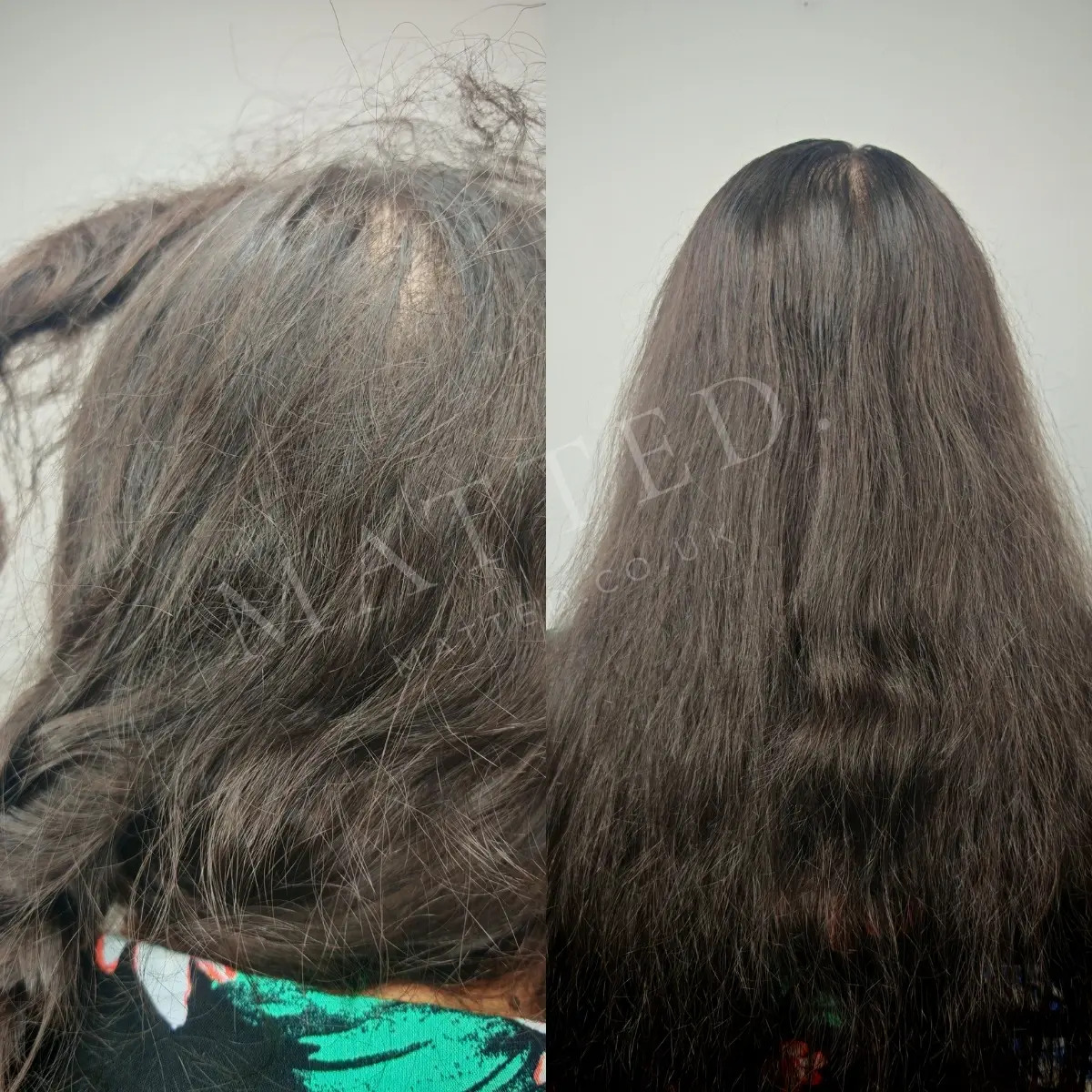
What Matted Hair Looks Like, Stage by Stage
What is matted hair at each stage? I grade every case on a five-step scale before I quote hours or price. The grades below are what I see on the head, in the order they appear.
| Grade | What it looks like | What your fingers feel | Where it usually starts |
|---|---|---|---|
| 1 · Tangles | Hair looks normal; a comb catches in places | Fingers pass through with a little resistance | Ends and underlayer |
| 2 · Knots | Small dense lumps a comb skips over; the lengths still move | Fingers stop at the lumps, pass elsewhere | Nape, behind the ears |
| 3 · Dense tangling | A felt-like band at the nape; the scalp is still visible between sections | Fingers move at the edges and stop at the centre | Nape and crown |
| 4 · Partial matting | Sections have fused into plates; the parting is hard to find | Fingers stop everywhere except the front | The whole back of the head |
| 5 · Full fusion | The head moves as one mass; the shape is a single shell | Nothing moves | Everywhere |
The nape is first in almost every case in my files: eight hours of pillow friction a night, the finest hair on most heads, and the part nobody sees in the mirror. On long hair the progression is fast. Hair over 40 cm left uncombed for two weeks or more mats past what can be fixed at home in about 60% of my recorded cases; that is not a failure of effort, it is the physics of length and friction.
"Hair matted to the scalp" is a phrase people search when the mat has reached Grade 4: the mass sits against the skin and you cannot get a finger between them. It is still hair, still attached at the root, and still opens from the outside in.
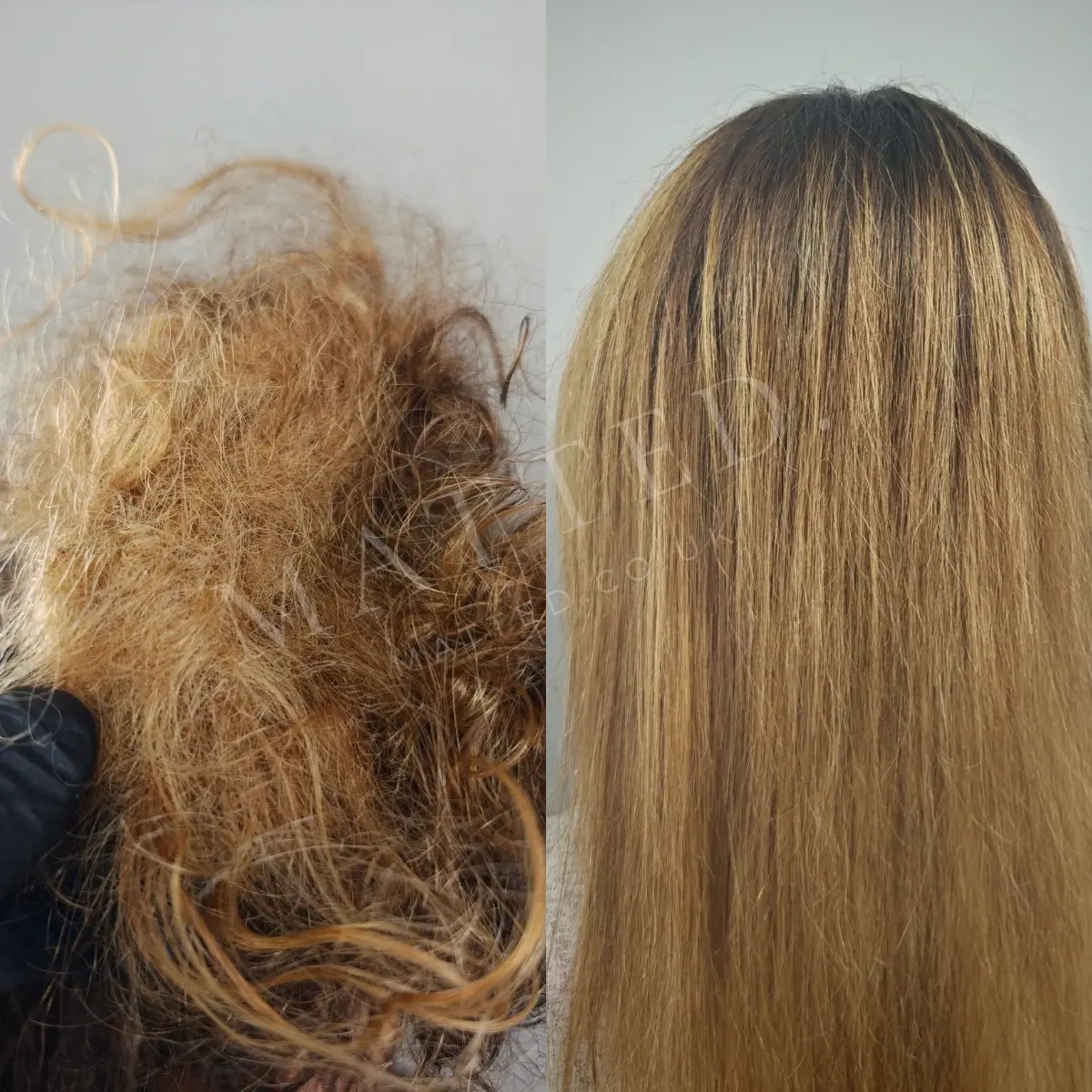
Tangled or Matted? The Ten-Second Test
Most people asking what is matted hair are really asking whether what they have is a bad tangle or something else. Take one section between finger and thumb and try to draw your fingers down through it.
- Your fingers pass through, with some catching: tangled. This is home-safe, dry, from the ends up, in small sections.
- Your fingers get stuck partway and the section will not give: send me a photo before anyone touches it.
- The section is solid and moves as one piece: matted. This is professional work, and the sooner the photo is sent, the fewer hours it takes.
The test matters because the two conditions need opposite handling. Tangled hair tolerates slip, gentle tension and a wide-tooth comb. Matted hair tolerates none of those until a section has already started to open; applied earlier, they lock it tighter. The full method, tangled and matted, is in the complete matted hair guide.
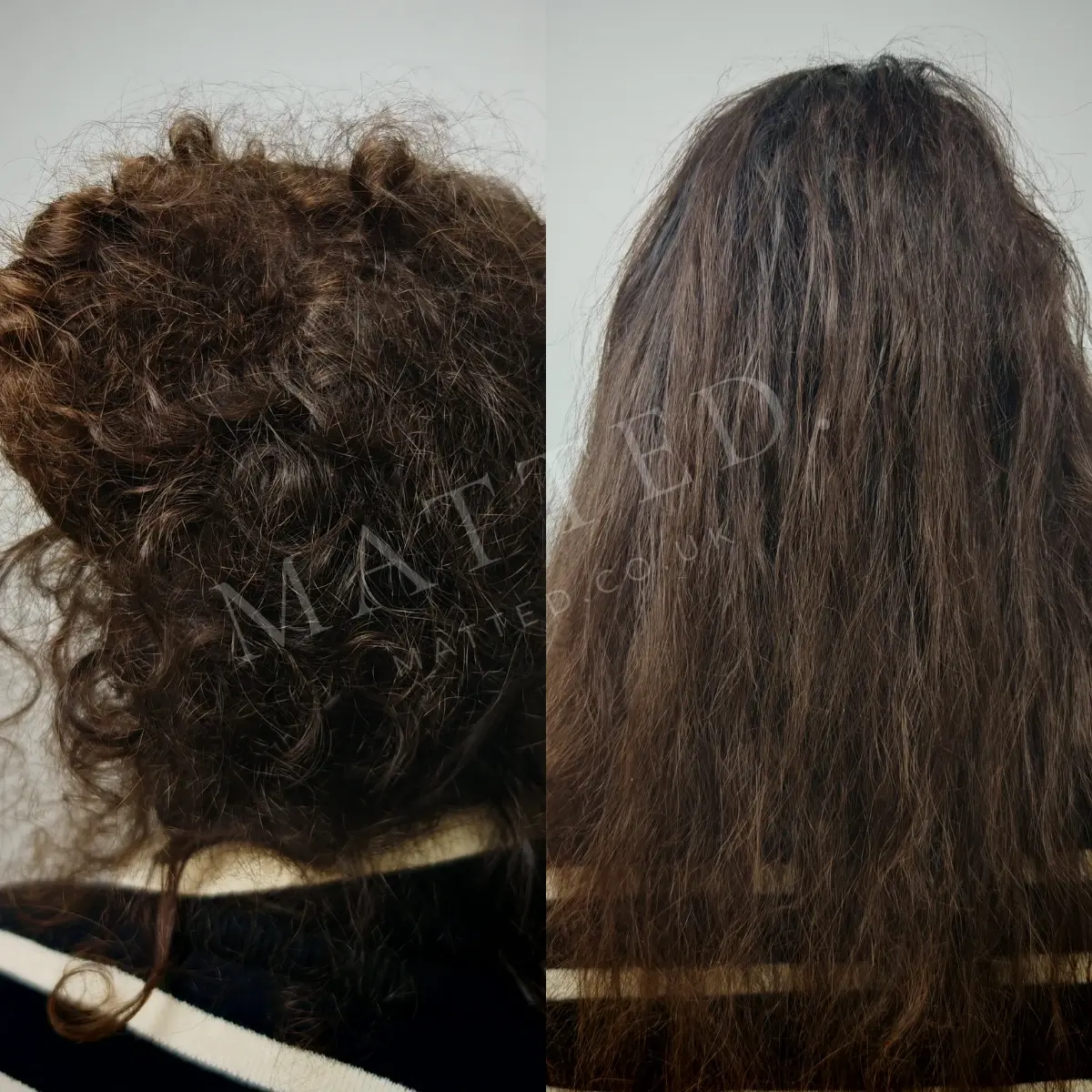
Why Hair Mats: The Six Things That Hold Shed Hair in Place
Any one of these on its own is survivable. Most of the matting I see is two or three of them overlapping, which is why some hair mats so easily while other hair never does.
- Brushing stops. Illness, low energy, a hospital bed, a newborn. Shed strands stay in from the first day.
- Friction. Pillows, collars, hats, car seats, headrests. The nape rubs eight hours a night.
- Moisture. Wet hair swells, the cuticle lifts, and lifted scales catch on each other. Sleeping on wet hair is the fastest route I know from tangled to matted.
- Product in the wrong place. Oil and conditioner at the roots gather shed hair into a paste. Coconut oil sets solid below about 24 °C, the temperature of most British homes.
- Attachments. Extensions, sew-ins and braids hold shed hair at the bond or the base; 30% of my London cases arrive as matted hair extensions.
- Texture and processing. Curly hair crosses itself at every turn; 68% of my severe cases involve curly-textured hair. Bleached hair has a raised cuticle that catches on everything.
The full breakdown, with the share of cases behind each cause, is in my analysis of 1,000+ UK cases.
Why Nothing Goes On a Mat First
Every guide that ranks for this question tells you to saturate the mat in conditioner, oil or water. My case files say the opposite, and here is the mechanism.
Water. Wet hair stretches up to 30% before it breaks. The movement you feel when working a mat that has been wetted is your own hair stretching, not the knot releasing, and the swollen cuticle locks harder as it dries.
Conditioner and masks. They coat the outside of the mass and cannot reach the knot at its centre. What they add is weight and water, and the water tightens what is underneath.
Oils. Coconut oil sets solid below about 24 °C and cements the knot; I find it in the worst mats I open. Olive oil is slippery for a while, then glues strand to strand.
Detangling sprays and remover creams. Made for tangles, where the strands are only crossed. On a mat they sit on the surface. No product opens a Grade 3 mat; 89% of recorded home attempts on severe cases made the restoration longer.
Slip product goes on only once a section has started to open under the fingers, and only on that section.
What You Can Safely Do at Home Tonight
This list is for the hair that still moves. It is not a method for opening a mat; that is professional work, and the next sections explain why.
- Leave it dry. Do not wash, wet or steam it.
- Take everything off it. If conditioner or oil is already on, do not try to wash it out; leave it and tell me.
- Plait what still moves, loosely, in several small three-strand plaits, so it stays out of the mat.
- Sleep on silk or satin, or in a satin bonnet, so the nape stops rubbing.
- On the parts your fingers pass through, work dry from the ends upward in small sections, fingers first, and stop the moment a section resists.
- Photograph the worst area in daylight, from behind, and send it to me. That is the whole task for tonight.
Stop if a section does not give within a few seconds of gentle work. Forcing it converts a tangle into a knot and a knot into a mat.
Matted Hair by Hair Type
| Hair type | How matting shows | Section size for home-safe work | What speeds it up |
|---|---|---|---|
| 1A to 2C, straight and wavy | A flat felt band at the nape; lengths often still free | Pencil-width | Wet sleeping, buns left in, collars |
| 3A to 3C, curly | Curls clump into accidental locs; edges look defined, centre is fused | Finger-width, one curl clump at a time | Skipped detangling on wash day, dryness |
| 4A to 4C, coily | Coils shrink and knot at crossing points; single-strand knots join up | Half a finger, worked coil by coil | Takedown of braids or extensions left past their wear time |
| Bleached or colour-treated, any type | Rough, catching texture; matting spreads fast from any knot | Smaller than the natural texture would need | Raised cuticle, heat, hard water |
Coily hair mats at the crossing points and needs its own approach; that page is matted afro and 4C hair. Hair left during a hospital stay mats at the nape within days; that situation is covered on matted hair after a hospital stay.
When to See a Professional
If the ten-second test says matted, the question is not whether it can be saved but how many hours it takes. The estimate comes from a photo, free, before anything is booked.
| Grade | Hours | Studio price |
|---|---|---|
| 1 · Tangles | 1 to 2 | £100 to £200 |
| 2 · Knots | 3 to 5 | £300 to £500 |
| 3 · Dense tangling | 6 to 9 | £600 to £900 |
| 4 · Partial matting | 10 to 14 | £1,000 to £1,400 |
| 5 · Full fusion | 14 or more, sometimes two sessions | From £1,400 |
£100 per hour. A £100 deposit secures the session and comes off the total. Home, hospital and care-home visits anywhere in London add a flat £200. Klarna pay-in-3 at 0% and Clearpay are accepted alongside card, Apple Pay, Google Pay, PayPal, Revolut, bank transfer and cash. The method for the worst cases, stage by stage, is written out in how to detangle severely matted hair without cutting.
How Matted Hair Is Restored at Matted Hair London
01
Assessment
From your photo, or in the first ten minutes at the studio, I grade the matting, check the scalp and give you hours and price.
02
Preparation
Nothing goes on the mat. I section what still moves and plait it away. The hair stays dry.
03
Restoration
I hold each section above the knot so your scalp feels nothing, find the loosest edge and open it strand by strand, tips to roots. When a strand resists, I leave it and work its neighbour; the mass gives way from the outside in. Ninety per cent of the work is by hand. Slip product goes on only once a section has started to open.
04
Finishing
Each freed section is plaited for protection, then deep conditioned. You leave with a written aftercare plan and 30 days of follow-up, and the routine in how to prevent hair from matting keeps it that way.
You can watch Netflix, talk, sleep or say nothing. I am Mental Health First Aid certified and I have never asked a client how it happened. The detangling service in London covers the studio, home visits and what to bring.
When Matting Has Been There for Months
Time changes hours, not outcome. Months of matting typically takes ten hours or more of patient work, sometimes across two sessions a week apart, and it comes out.
Two things to expect afterwards. You will see hair: what comes out of a mat is the hair that shed while it was forming, 50 to 100 strands a day for as many days as it was left, and it is not new loss. And if the mat sat tight against the scalp for a long time, the roots may be tender and the hairline thinner; that is traction, and in my case files regrowth typically begins within three months once the tension is gone. If the scalp is sore, scabbed or patchy, see your GP; a dermatologist can confirm traction alopecia early, when it is still reversible. The NHS page on hair loss explains when to seek help, and the British Association of Dermatologists has a patient leaflet on traction alopecia.
From 1,000+ documented matted hair cases: 99% were saved without cutting, and 73% of clients had already been told by another salon that cutting was the only option. It was not.
Frequently Asked Questions
What does matted hair mean?
Matted hair means hair in which the strands you shed every day, 50 to 100 of them, have stayed in and locked around the hair still growing, until a brush can no longer pass. That is the whole answer to what is matted hair. A tangle is strands crossed; a mat is strands interlocked at the cuticle, in a mass that moves as one piece. The medical term for severe felting is plica neuropathica.
What does matted hair look like?
Early on, a dense lump at the nape that a comb skips over. Later, a felt-like band along the back of the head, sometimes with the scalp visible between fused sections. In the final stage the whole head moves as one mass. In my case files the nape is almost always first: eight hours of pillow friction a night on the finest hair.
Is matted hair the same as tangled hair?
No. Tangled hair still separates under your fingers; matted hair does not. The ten-second test settles it: if your fingers pass through a section, it is tangled and safe to work at home; if they get stuck, send a photo; if the section is solid, it is matted and that is professional work. The difference decides the method.
Can matted hair be saved or does it have to be cut?
It can almost always be saved. Across 1,000+ documented cases since 2020, 99% were restored without cutting, including full-head fusion and months of matting. What changes with severity is hours, not outcome. Cutting is a last option, and 73% of my clients had been told it was the only one before they found me.
Why does hair mat?
Because shed hair has nowhere to go. Every head loses 50 to 100 strands a day, and brushing carries them out. When brushing stops, or friction, moisture and product hold them in place, they wrap around living hair and lock at the cuticle. In my case files 42% of severe matting followed depression, illness or a hospital stay, and 30% of London cases involve extensions.
How long does it take for hair to mat?
Weeks, not months, for long hair. Hair over 40 cm left uncombed for two weeks or more becomes impossible to fix at home in about 60% of cases in my records. Short hair and straight hair take longer; curly hair, bleached hair and hair worn under extensions or a bun take less.
Is it spelt matted or matt hair?
Matted, with two t's and an -ed, so the question is what is matted hair, never matt hair. Matt describes a flat, non-shiny finish; matted describes hair that has locked into a mass. Hair matting, a mat of hair and dematting (the process of opening a mat) all follow the same spelling. There are 313 answered questions on the FAQ page if yours is not here.
Send a Photograph, Get an Honest Answer.
One photo of the worst area, in daylight, from behind, is enough. You will have the grade, the hours and the price back before you decide anything. £100 per hour at my Catford studio, three minutes from Catford Bridge, or at your home anywhere in London for a flat £200 more. The £100 deposit comes off the total, and you can pay in three at 0% with Klarna. You will not be rushed, judged or asked what happened.