By Vitalii Prisacari, VTCT Level 3 Diploma in Women's Hairdressing, including the Level 4 Hair and Scalp unit, State Registered Graduate Hairdresser, founder of Matted Hair London. Helped 1,000+ people since 2020. Reviewed 13 September 2026.
Matted Hair Extensions: Removed Without Losing Your Own Hair.
10 min read · Updated 13 September 2026 · Vitalii Prisacari
Why extensions mat at the root, what never goes on them, and how the bonds come out with your own hair still attached to your head.
Matted hair extensions can be removed without cutting your own hair. The bonds are separated one at a time, on dry hair, with fingers before any tool, and nothing is applied to the mat first. Three in ten of my London clients arrive this way, most of them after being told the only option was scissors.
30%
Of London Cases Are Extensions
99%
Saved Without Cutting
1,000+
Cases Since 2020
Read this first
- Keep the extensions dry. Water tightens the mat around the bonds.
- Put nothing on the bonds: no remover, no oil, no conditioner, no detangling spray, nothing overnight.
- Do not pull a weft, tape or ring through a knot. Do not cut the track: the hair growing through it goes with it.
- Fingers only, and only on bonds that still slide freely.
- Sections that are not yet matted can be plaited loosely so they do not join the mat.
- The safest first step is a free 10-minute photo assessment on WhatsApp.
Key takeaways
Extension matting is shed hair with nowhere to go: 50 to 100 strands a day, trapped at the bond. 30% of my London cases are extension-related, and many clients had already been told to cut. Across 1,000+ matted hair cases, 99% were saved without cutting; matted extensions are not the exception. Dense matting around bonds usually sits at Grade 3, £600 to £900, 6 to 9 hours. The extensions rarely survive; your own hair does.
Why Do Hair Extensions Mat at the Root?
Extensions mat at the root because the hair you shed every day cannot leave. A free strand falls out when you brush; a strand held at a bond wraps around the attachment instead. After a few weeks there are hundreds of them, and they lock the bonds to each other and to your growing hair.
Four things speed it up, and I see them in that order in the case files:
- Going past the wear time. Every method has a limit before the bonds grow out and start to twist. The wear times and takedown rules for each style are on my page about honest wear times for braids, wefts and wigs. Most extension mats I open had passed that limit by weeks.
- Sleeping with the extensions wet or damp. Wet hair swells, the cuticle lifts, and eight hours of pillow friction does the rest at the nape.
- Product at the bond. Oil and conditioner applied at the root soften tape and keratin, gather dust and shed hair, and set into a paste.
- Chemical processing on top. Bleached hair has a raised cuticle that catches on everything; see what bleach does to the cuticle.
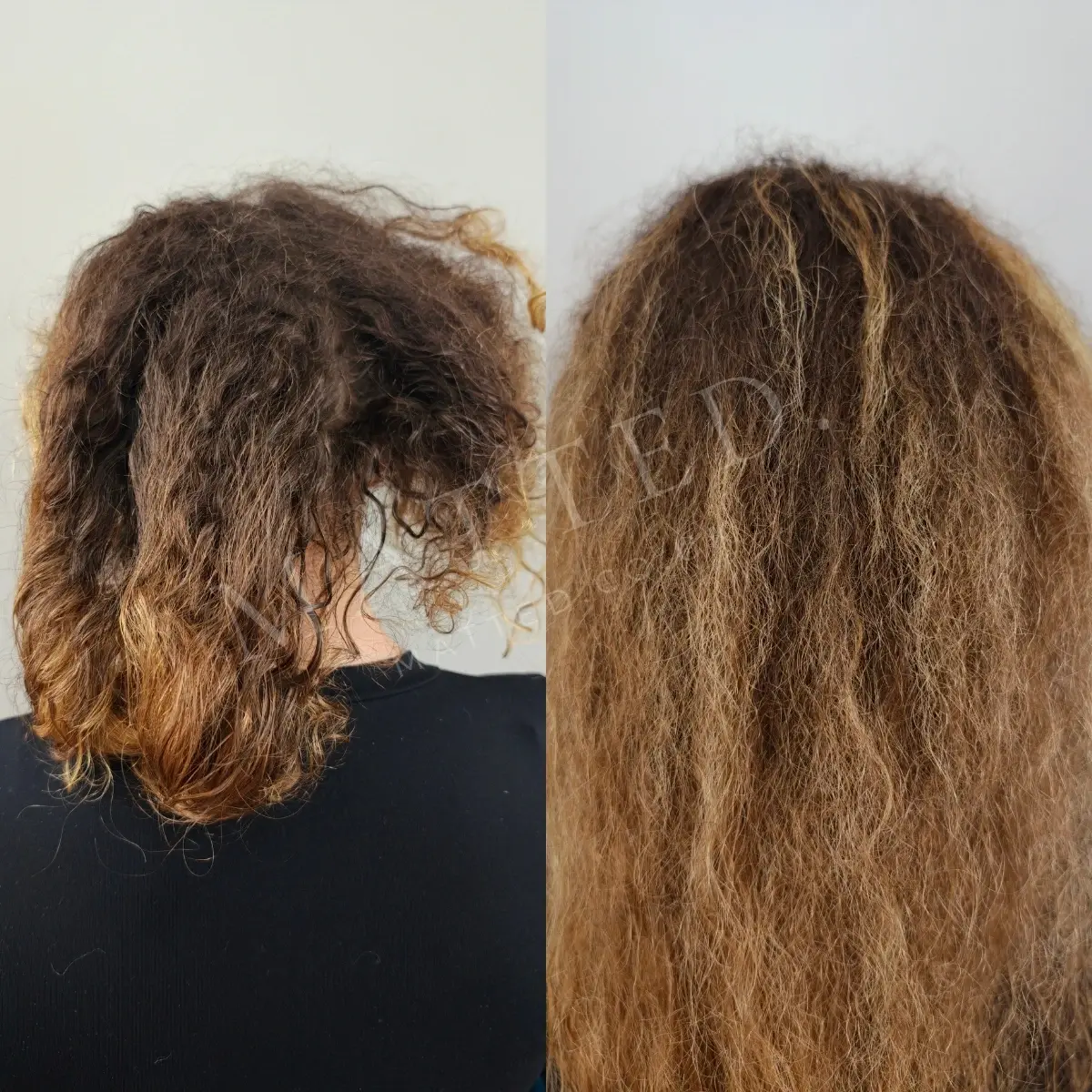
Tape-In, Weft, Nano-Ring, Bonded: What Matting Looks Like on Each
| Method | What the mat looks like | Home-safe? | What I do |
|---|---|---|---|
| Tape-in | Two tapes and the hair between them fold into a flat, hard plate at the root; neighbouring plates join | Only if each tape still lifts freely | Open the plate from its outer edge; separate tape from tape before tape from hair |
| Weft / sew-in | The braid track disappears into a felt-like band; the thread is buried | No | Find the thread by touch, release the stitching, then work the track out of the natural hair |
| Nano-ring / micro-ring | Rings sink into a knot of shed hair; you feel beads inside a lump | No | Free each ring's own strand before touching the next; rings are opened, never pulled |
| Bonded / keratin | Keratin tips fuse with shed hair into hard beads at the scalp | No | Warm the section by hand only, never solvent on a mat; separate tip by tip |
| Clip-in | Comb teeth caught in a nest, usually at one side | Sometimes | Release the comb by opening the nest around it, not by pulling the clip |
Whatever the method, the pattern is the same: the mat starts at the bond and spreads outward. That is why cutting "just the bond" never works. The bond is the centre of the knot, and your hair runs straight through it.
Tangled or Matted? The Ten-Second Test
Take one bond between finger and thumb and try to slide it a few millimetres along the hair.
- It slides, and the hair around it separates: tangled. Book a maintenance appointment with your fitter this week.
- It moves a little and catches: send me a photo before anyone touches it.
- It does not move, and the bonds around it feel like one piece: matted. This is professional work.
The same test, and the full method behind it, is in the complete matted hair guide; the five grades it refers to are defined on what is matted hair.
What Not to Do
- Do not apply bond remover to a mat. Remover is designed to reach a clean bond. On a knot it sits on the outside, soaks the shed hair, and makes the mass heavier and slower to open.
- Do not oil it. Coconut oil sets solid below about 24 °C, the temperature of most British homes, and cements the knot. Olive oil is slippery for a while, then glues strand to strand. I see both in the worst mats.
- Do not wet it. Wet hair stretches up to 30% before it breaks, and a wet mat around a bond tightens as it dries. The "progress" you feel is your own hair stretching.
- Do not cut the track out. The hair growing through the track leaves with it. That is the loss you were trying to avoid.
- Do not let a salon shave the section as a first option. Across 1,000+ matted hair cases, 99% were saved without cutting. Matted extensions are not the exception.
What You Can Do While You Wait
- Stop washing. Dry hair is easier to open and cannot get worse in the shower.
- Sleep on silk or satin, or in a satin bonnet, so the nape stops rubbing.
- Plait the sections that still move freely, loosely, so they stay out of the mat.
- Photograph the worst area in daylight, from behind, and send it to me. I will tell you the grade, the hours and the price before you spend anything.
- Do not book a removal with anyone who has not seen the photo.
How I Remove Matted Extensions in London Without Cutting Your Own Hair
Every case runs through the same four stages, whether the mat is one tape or the whole head.
01
Assessment
From your photo, or in the first ten minutes at the studio, I map where the bonds are, how far the mat has spread and whether the scalp is sore. You get an estimate in hours and pounds. A £100 deposit secures the session and comes off the total.
02
Preparation
Nothing goes on the mat. I section what still moves and plait it away. The hair stays dry.
03
Separation, bond by bond
Ninety per cent of the work is done by hand. I hold each section above the bond so your scalp feels nothing, find the outermost free strand and release it, then the next. When a strand resists, I leave it and work its neighbour; the mass gives way from the outside in. Slip product goes on only once a section has started to open. Rings are opened, tapes are peeled from tapes, thread is cut, never hair.
04
Finishing
Each freed section is plaited for protection, then deep conditioned. You leave with a written aftercare plan for the hair under the extensions and 30 days of follow-up. Home visits run the same way, anywhere in London, with a discreet arrival and everything brought.
You can watch Netflix, talk, sleep or say nothing. I am Mental Health First Aid certified and I have never once asked a client how it got this way. The general service, studio and home visits, is described on matted hair removal in London; the method for the worst mats, stage by stage, is in how a mat is opened without cutting.
Cost and Time
| Grade | What it looks like on extensions | Hours | Studio price |
|---|---|---|---|
| 1 · Tangles | Bonds slide; shed hair building at the root | 1 to 2 | £100 to £200 |
| 2 · Knots | Some bonds joined; a comb still moves through the lengths | 3 to 5 | £300 to £500 |
| 3 · Dense tangling | Bonds fused into plates or bands; scalp visible | 6 to 9 | £600 to £900 |
| 4 · Partial matting | Sections of bonds and natural hair fused as one | 10 to 14 | £1,000 to £1,400 |
| 5 · Full fusion | The whole head moves as one mass | 14 or more, sometimes two sessions | From £1,400 |
£100 per hour. Home visits across London add a flat £200. Klarna pay-in-3 at 0%, Clearpay, card, Apple Pay, Google Pay, PayPal, Revolut, bank transfer and cash are all accepted. The 10-minute consultation is free and carries no commitment. Most cases need one session; Grade 4 and 5 occasionally take two, a week apart.
After Removal: The Clump, the Tension, the Regrowth
Expect to see hair. What comes out with the bonds is the hair that shed while the extensions were in: 50 to 100 strands a day for as many days as you wore them. It looks alarming and it is not new loss.
If the bonds sat tight for a long time, the roots may be tender and the hairline thinner. That is traction, and it usually recovers; in my case files regrowth typically begins within three months once the tension is gone. If the thinning is patchy or the scalp is sore or scabbed, see your GP; a dermatologist can confirm traction alopecia early, when it is still reversible. The NHS page on hair loss explains when to seek help, and the British Association of Dermatologists has a patient leaflet on traction alopecia.
Give your own hair a rest before re-installing anything. When you do go back, the wear time your fitter gives you is a limit, not a suggestion; the four to six week rule for protective styles applies.
From 1,000+ cases: 30% of my London clients arrive with extension-related matting, and many clients had already been told by another salon that cutting was the only option. It was not.
Frequently Asked Questions
Why do my hair extensions mat at the root?
Because the hair you shed every day, 50 to 100 strands, cannot fall out when it is held at the bond. It stays, wraps around the attachment and the neighbouring bonds, and locks. Wet sleeping, product at the bond, scalp rubbing and going past the wear time speed it up.
Can matted hair extensions be saved without cutting?
Yes. Across 1,000+ cases, 99% were saved without cutting, and extension matting is 30% of my London work. The bonds are separated one at a time on dry hair with fingers first. Your own hair stays; the extensions usually come out and are rarely worth reusing.
Can I remove matted extensions myself?
Not safely once the bonds have fused. Remover solvents and oils do not reach a knot, and cutting the track cuts the hair growing through it. If a bond still slides freely between your fingers you are early enough to book a maintenance appointment; if it does not move, send a photo before doing anything.
How much does it cost to remove matted extensions?
£100 per hour, with a free 10-minute estimate first. Tangles you can still open with your fingers are £100 to £200; dense matting around the bonds usually falls in Grade 3 at £600 to £900; fused sections are Grade 4 and above. A £100 deposit comes off the total, and Klarna pay-in-3 is available.
Will I lose my own hair when matted extensions are removed?
You will see hair come out, and almost all of it is hair that shed while the extensions were in. It looks like loss because weeks of it are released at once. Your growing hair stays attached because nothing is cut and nothing is pulled through a knot.
Can the extensions be reused after matting?
Rarely. Matted bonds are usually damaged by the time they are freed, and tape or keratin cannot be trusted a second time. I will tell you honestly once the section is open. Plan on a rest period for your own hair before anything is re-installed. There are 313 answered questions on the FAQ page if yours is not here.
Book a Free Extension Assessment in London.
One photograph is enough to start. Send it on WhatsApp to +44 7902 020201 and you will have the grade, the hours and the price back before you decide anything. Sessions are £100 per hour at my Catford studio, three minutes from Catford Bridge, or at your home anywhere in London for a flat £200 more. The £100 deposit comes off the total, and you can pay in three at 0% with Klarna. You will not be rushed, judged or asked what happened.