Written by Vitalii Prisacari, VTCT Level 3 certified matted hair specialist and founder of Matted Hair London, with 23 verified qualifications and 1,000+ documented restorations. Reviewed September 2026.
Matted Hair in Elderly and Dementia Care: A Carer's Guide.
10 min read · Updated 15 September 2026 · Vitalii Prisacari
It is not a failure of care. Why hair mats in later life, what to do in the next ten minutes, how to approach someone who will not let you near their head, and why it almost always comes out without cutting.
Hair mats in later life for two ordinary reasons at once: the nape rubs against a pillow or a chair back for eight hours or more a night, and the daily brushing stops. Shedding carries on regardless, 50 to 100 strands a day, and those strands stay in and lock around the hair still growing. It is a gap in a routine, not a failure of care, and across 1,000+ documented cases 99% came out without cutting.
99%
Saved Without Cutting
1,000+
Documented Cases
2,800+
Shed Strands By Week Four
Read this first
- Keep the hair dry and do not wash it. Water makes a mat heavier and tighter, never looser.
- Put nothing on it: no conditioner, no oil, no detangling spray, no overnight mask.
- Never force a comb through a mat, and never force hair care on someone who is refusing.
- Do not let a shave go on a care plan before someone has looked at the hair. 99% of 1,000+ cases were saved.
- A sore, broken or weeping patch of scalp under the hair is one for the GP before anything else.
- One photo of the back of the head on WhatsApp gets you the grade, the hours and the price, for free.
Key takeaways
Hair mats in later life because the nape carries the night's friction and the brushing stops, not because of poor hygiene. Shedding continues at 50 to 100 strands a day whether hair is brushed or not, and by the fourth week a mat can hold over 2,800 trapped strands, which is why it seems to appear overnight. A thirty-second nape check every day is the most useful thing a carer can do. Where someone resists having their hair touched, stopping is more productive than pushing: force teaches bracing, and bracing lasts longer than the mat. Across 1,000+ documented cases, 99% came out without cutting, and 73% of those clients had already been told by someone else to cut it off.
Why Hair Mats in Later Life and in Dementia
Three things happen at once, and any one of them alone would be manageable.
The first is the pillow. Someone who spends more hours in bed or in the same armchair rubs one patch of hair against one piece of fabric for eight hours or more every night. That patch is almost always the nape, the hair at the back of the head just above the neck. It is the finest hair on the head, it gets the least brushing, and it carries all of the night's friction. In my case files the nape is where matting starts more often than everywhere else combined.
The second is shedding, which does not stop. Everyone loses 50 to 100 strands a day. In hair that is brushed, those strands fall away. In hair that is not, they stay in and wrap around the hair still growing. That is the whole mechanism of matted hair, and it is why a mat seems to appear from nowhere: by week four it can be holding over 2,800 shed strands, all of which arrived one ordinary day at a time.
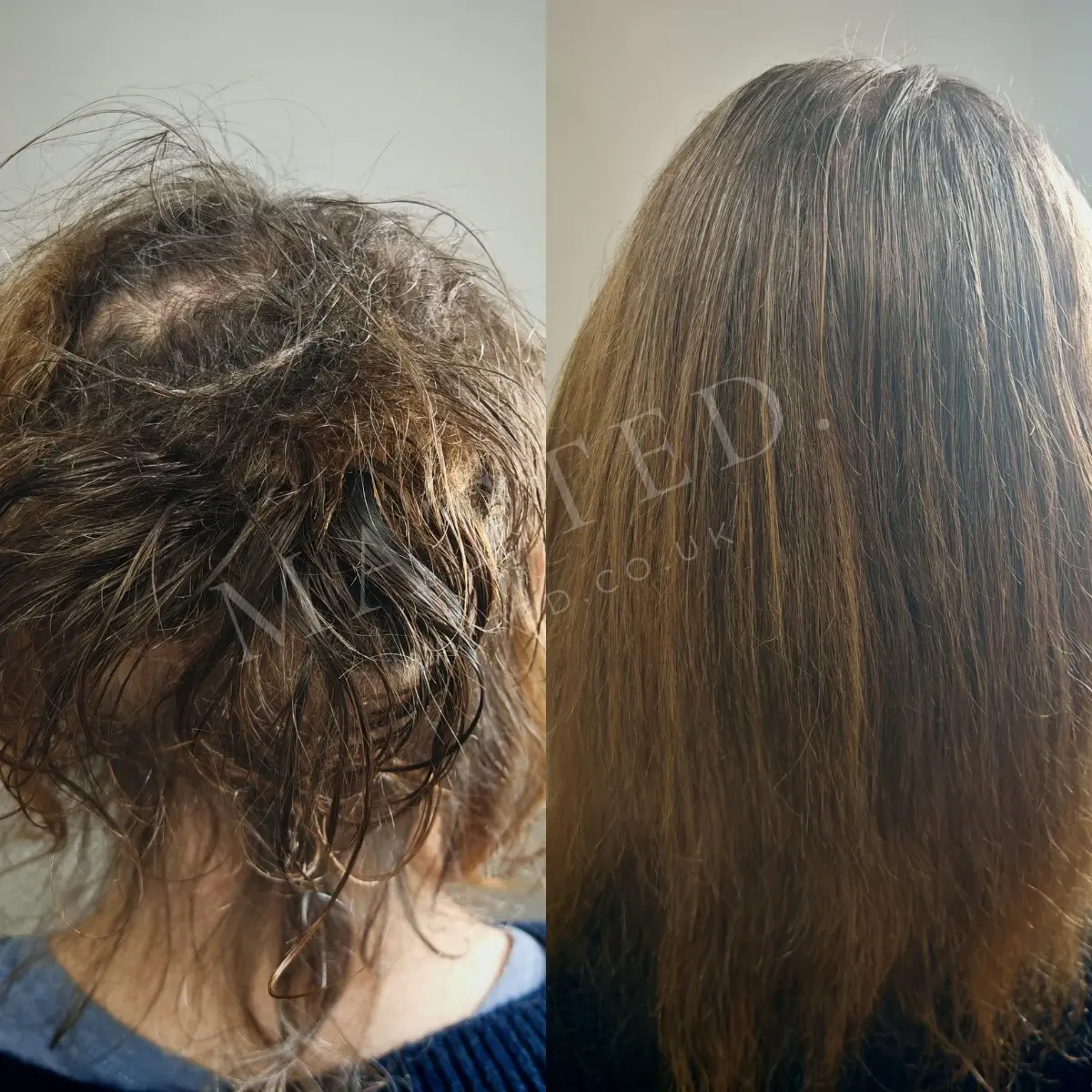
The third is that brushing stops, or becomes a negotiation. In dementia, hair care can be one of the first parts of a routine to go, because it involves standing behind someone, touching their head, and doing something they cannot always follow. If it goes badly once, the next attempt starts from further back. Nobody decides to stop brushing. It just becomes the thing that gets dropped on a day when there are ten other things.
Hair in later life also tends to be finer and drier, which makes shed strands catch rather than slide. If you have noticed the hair getting much drier recently, a pharmacist is the person to ask whether anything on the prescription list is known for that. It is not something to guess at, and it is not something to treat with more product.
It Is Not a Failure of Care
Almost every carer I meet says a version of the same sentence in the first two minutes, and it is always an apology.
It should not be. Hair is the part of personal care that gets dropped first, everywhere, in every setting, because it is the part with no immediate consequence. Nobody is harmed today by hair that was not brushed today. The consequence arrives four weeks later, all at once, and by then it looks like months of neglect compressed into one object. It is not. It is a gap in a routine, and it is the most common single reason people end up in my studio.
You should also know what the rest of the industry does with this. In my case files, 73% of clients arrived after another salon had recommended cutting the hair off. That is not because the hair could not be saved. It is because most salons are not set up to spend nine hours on one head, so the honest answer for them is scissors. Being told to cut it is not a verdict on the hair, and it is certainly not a verdict on you.
What You Can Do Today
Five things, in order. None of them takes long, and the first four are free.
01
Keep it dry
Do not wash the hair, do not wet the mat, and do not let a shower run over it. A wet mat is heavier and tighter than a dry one, and wet hair stretches before it breaks, which means damage you cannot see until it dries.
02
Check the nape every day
Lift the hair at the back of the head, put two fingers underneath, and see whether the strands separate. Thirty seconds. If they part, even slowly, you have caught it. If the section moves as one piece, stop there and read the next section.
03
Loosely plait whatever still moves
One soft plait, or two, with a fabric-covered band and no tension at the roots. This stops loose hair from feeding the mat overnight, and it is the single most effective preventive step in a care setting.
04
Change the pillowcase to silk or satin
Cotton grips hair and holds it in place while the head turns against it. Silk and satin let it slide. This is cheap, it lasts, and it removes most of the friction that builds the nape mat in the first place.
05
Send a photograph
One picture of the back of the head, in daylight if you can, on WhatsApp. The 10-minute assessment is free, it tells you which grade you are dealing with and roughly how many hours it means, and there is no obligation attached to it.
What Not to Do
Do not put conditioner, oil or detangling spray on a mat. Every one of them is either water-based or greasy, and neither adds separation. Both add weight. In my case files 89% of recorded home attempts made the professional work longer rather than shorter, and most of those attempts started with a product.
Do not drive a comb through it. This is the one that does lasting harm, and it happens most often with the best intentions, usually with a comb that was to hand. Forcing teeth through felted hair tears the strands that are still attached and pulls directly on the scalp of someone who may not be able to tell you clearly that it hurts.
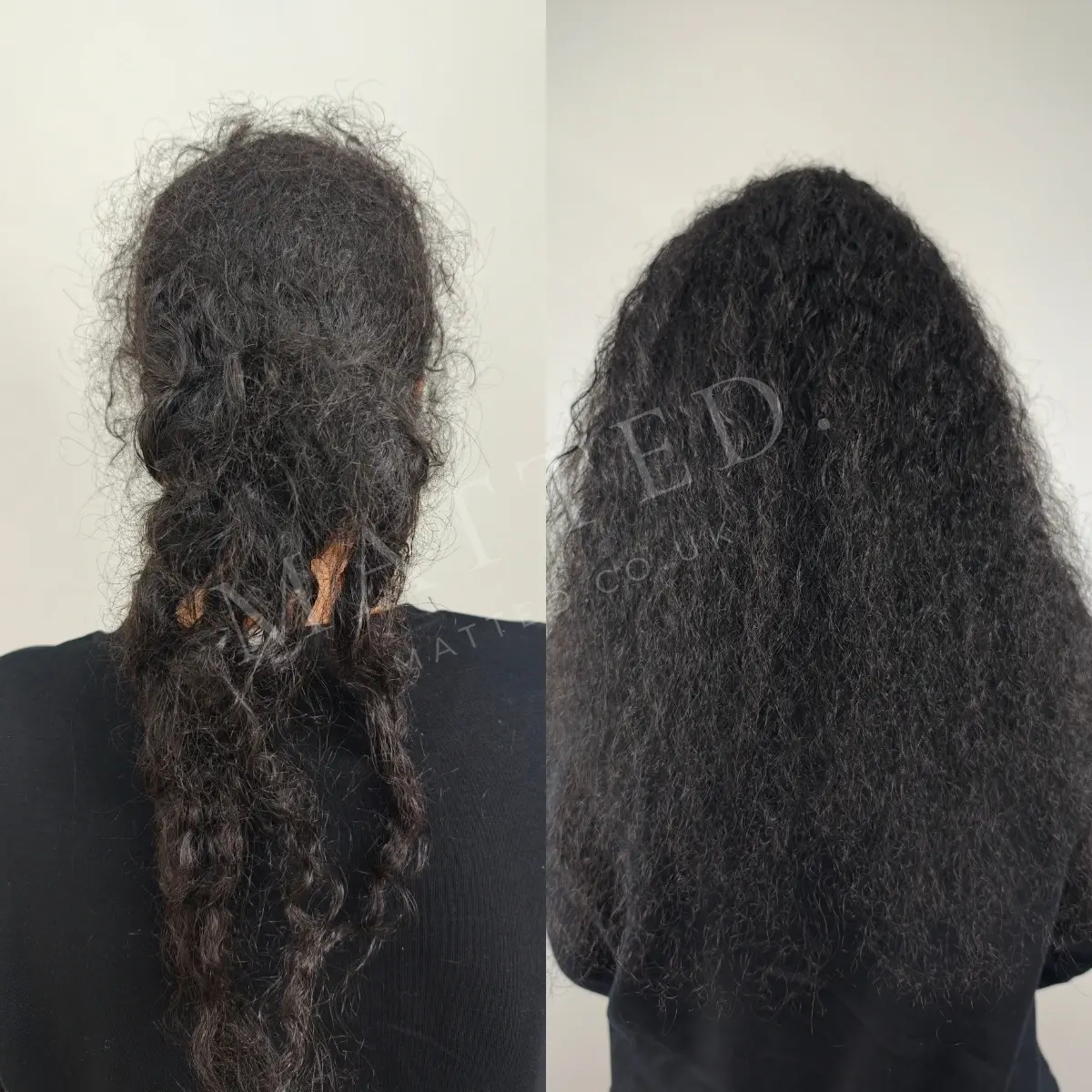
Do not cut into it to get a start. A cut into a mat removes the length that is holding the section together and makes the remaining work harder to control, not easier. It also removes the option of saving it.
Do not let a shave go on a care plan before someone has assessed the hair. A photograph and a free assessment will tell you whether it is saveable. That answer takes an hour and costs nothing, and it is a lot easier to have before a decision than after it.
When They Will Not Let You Near Their Hair
This is the part that the general advice never covers, and in dementia care it is usually the real problem. The hair is not matted because nobody tried. It is matted because trying went badly.
Do not force it. That is the whole principle, and everything else follows from it. Forcing personal care on someone who is refusing teaches them that hands near their head mean something unpleasant, and that lesson outlasts the memory of the event itself. The hair can wait a day. The bracing does not undo in a day.
What helps, in the order I use it myself:
- Stand where they can see you, at the side rather than behind. Approaching a head from behind is startling for anyone, and for someone who cannot place who you are, it is worse.
- Say what you are about to do before you do it, in short sentences, and then do exactly that. Narrating as you go is not fussing. It is the difference between contact that makes sense and contact that does not.
- Work for one minute, not ten. A minute of hair care that ends calmly is worth more than ten that end badly, because the next one starts from where the last one finished.
- Pick the time of day when they are most themselves, and stop the moment they say stop, in words or otherwise. Stopping when asked is what makes the next attempt possible.
If hair care has become a regular battle and the hair is already matting, that is not a sign to try harder. It is the point to bring in someone who does this all day. I work to the same rules in the studio and at the bedside, and I hold Dementia Awareness for Hair, Beauty and Wellbeing (2021), Understanding the Principles of Dementia Care (2026) and Safeguarding Adults and Vulnerable Clients (2020), but the reason it usually goes well is simpler than training: I am not in a hurry, and nothing else is waiting.
Can It Be Saved Without Cutting?
Almost always, yes. Across 1,000+ documented restorations since 2020, 99% came out without cutting, and that includes hair that had been matted for months.
What changes with time is not whether it can be saved but how long it takes. On my five-grade scale, tangles that still open with fingers are Grade 1 and take an hour or two. Knots a comb still moves through are Grade 2, three to five hours. Dense tangling that needs professional tools is Grade 3, six to nine hours. Sections fused into mats with the scalp still visible are Grade 4, ten to fourteen hours. A head that moves as one mass is Grade 5, fourteen hours or more, sometimes across two sessions a week apart. The full method is set out in my guide to severely matted hair.
Nothing on that scale is a point of no return. Waiting does not make hair unsaveable, it makes saving it slower. The reason to move now is comfort and cost, not possibility.
What comes away during the work is the shed hair that had been trapped inside the mat for weeks. Families often brace for that moment and find it alarming. It is not new loss, and it is not damage. It is the 50 to 100 strands a day that should have fallen out on the pillow and could not.
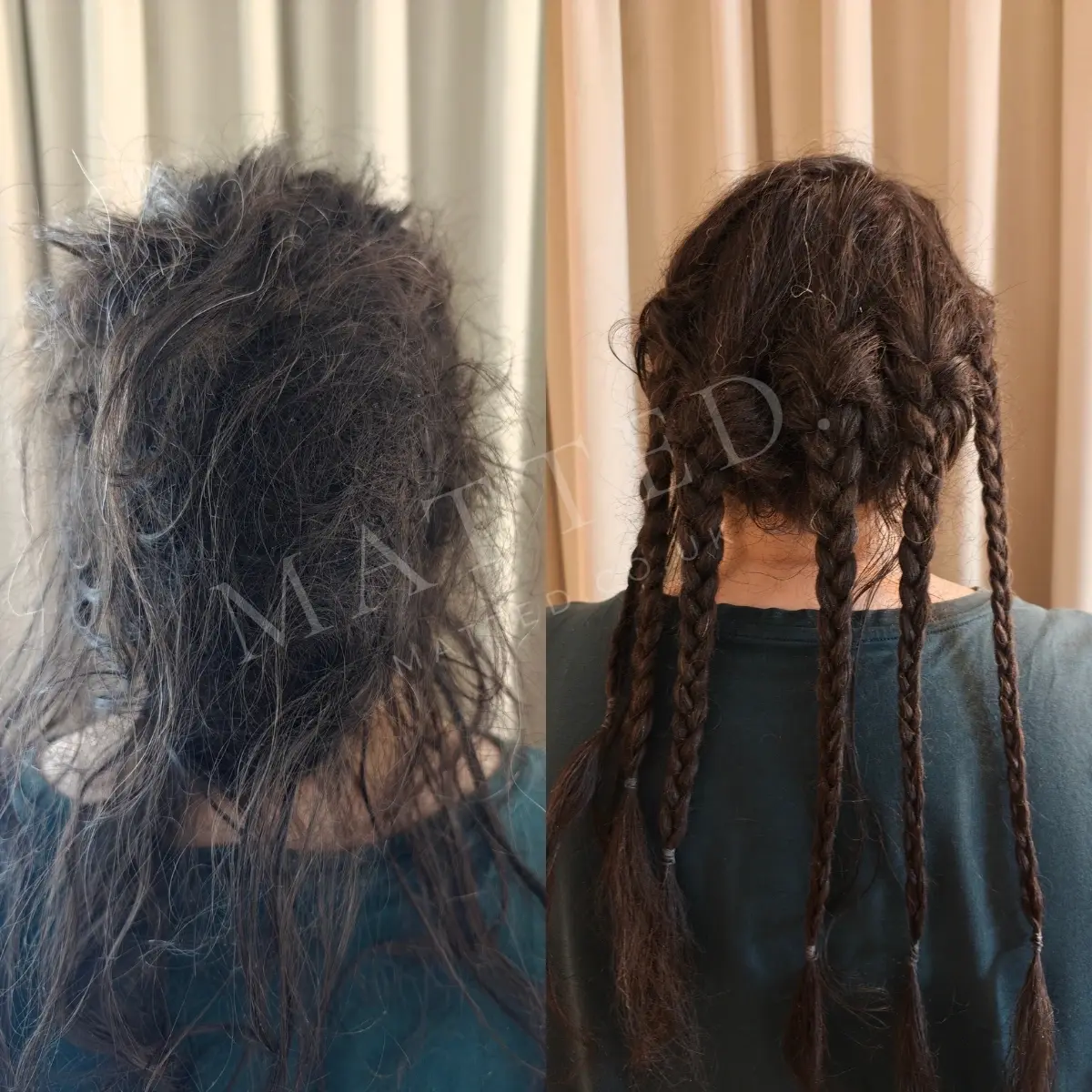
How a Care-Home or Home Visit Works
Short version, because the full account of how a bedside restoration works is on the hospital page and this one does not need to repeat it.
I come to the person. Care homes, nursing homes, hospices, hospitals and private homes, across all London boroughs, arriving discreetly and in an unmarked car. I bring the full professional setup, including Barbicide hospital-grade disinfection between clients, fresh towels and single-use items, which is what makes the work safe for immunocompromised and post-surgical clients.
The pace belongs to the person, not to me. We break whenever breaks are needed, the session can be split across days, and a carer or family member stays in the room throughout if that helps. Nobody is asked to explain how the hair got this way. The rate is £100 per hour with a flat £200 visit surcharge, and the free assessment beforehand gives you the hours and the figure before anything is agreed.
From 1,000+ documented matted hair cases: 99% were saved without cutting, and 73% of clients had already been told by another salon that cutting was the only option. By the fourth week a mat holds over 2,800 shed strands, which is why the nape fuses before anyone notices it forming.
For Family, Care Staff and Managers
If you are the one arranging this rather than the one doing it, four things make it go smoothly.
Send the photograph yourself, early. The back of the head, in daylight. Everything else follows from that picture: the grade, the hours, the figure. It is the difference between a plan and a guess.
Say what I need to know about the person, not about the hair. Mobility, whether they can sit or need to stay in bed, how they are with touch, what time of day is best, whether there is a sensory issue, and anything that makes them anxious. That shapes the session far more than the hair does.
Settle who is consenting, and involve the person as far as they are able. If someone else holds authority to decide about personal care, have that clear before the visit. If the person can express a preference, it counts, and I will stop if they want me to stop regardless of what was arranged.
Tell the budget holder the range in advance. The free assessment gives you hours and a figure before anything is booked, so nobody is agreeing to an open-ended cost. Klarna pay-in-3 at 0% and Clearpay are available, and the £100 deposit comes off the final total rather than sitting on top of it.
One last thing, for the person doing the caring. In this work, the hair is almost never the reason the room feels the way it does. Getting it sorted does not fix what is underneath it, but it gives back something that belongs to the person, and they usually know it.
Frequently Asked Questions
How do you detangle matted hair on an elderly person?
Dry, from the ends upward, in small sections, with fingers before any tool, and with the hair supported above the tangle so nothing pulls at the scalp. Nothing goes on the mat first. If a section moves as one solid piece it has passed the point a carer can safely work on, and it needs someone trained. Across 1,000+ documented cases, 99% were saved without cutting.
Why does hair mat at the back of the head in elderly people?
Because the nape carries the night. Someone who spends more hours in bed or in a chair rubs the same patch of hair against the same fabric for eight hours or more, and the 50 to 100 strands shed each day stay in and lock around the growing hair instead of falling away. By the fourth week a mat can hold over 2,800 shed strands. That is why the nape fuses first and why it is the spot to check daily.
What should a carer do if someone will not let them brush their hair?
Stop, and do not force it. Forcing turns hair care into something the person braces against, and the next attempt is harder. Stand where they can see you, say what you are about to do before you do it, work for a minute rather than ten, and come back at a better time of day. If brushing has become a regular battle and the hair is already matting, that is the point to bring in someone trained rather than to try harder.
Do you visit care homes for matted hair?
Yes, across all London boroughs, including care homes, nursing homes, hospices, hospitals and private homes. I bring the full setup, work at the pace the person sets, take breaks whenever they are needed, and a carer or family member can stay throughout. Arrival is discreet and unmarked. The rate is £100 per hour with a flat £200 visit surcharge, and the assessment beforehand is free.
How much does it cost to remove matted hair for an elderly relative?
£100 per hour, plus a flat £200 surcharge for a home or care-home visit. The hours come from the grade: Grade 3 dense tangling is 6 to 9 hours (£600 to £900), Grade 4 partial matting is 10 to 14 hours (£1,000 to £1,400), Grade 5 full fusion is 14 hours or more (from £1,400). The free 10-minute photo assessment gives a range before anything is booked, so a family or a budget holder knows the figure in advance, and Klarna pay-in-3 at 0% is available.
Does detangling matted hair hurt?
It should not. The hair is held above the section being worked on so the pull never reaches the scalp, and the work stops the moment the person wants it to stop. Pain comes from the opposite approach, dragging a comb down through felted hair, which is what makes someone refuse to be touched again. For a person who cannot say clearly that something hurts, that difference matters more than anywhere else.
Should matted hair be shaved off if someone is in a care home?
Not before someone has looked at it. In my case files 73% of clients arrived after another salon had recommended cutting, and 99% of cases were saved without it. A photograph and a free 10-minute assessment will tell you whether the hair is saveable before a shave goes on a care plan, and that answer costs nothing.
Send a Photo When You Are Ready
One picture of the back of the head. I will tell you honestly whether it can be saved without cutting, roughly how many hours it will take, and what that comes to. The assessment takes ten minutes, it is free, and it commits you to nothing. WhatsApp or phone +44 7902 020201.