Written by Vitalii Prisacari, VTCT Level 3 certified matted hair specialist and founder of Matted Hair London, with 23 verified qualifications and 1,000+ documented restorations. Reviewed September 2026.
Matted Hair After Depression: 99% Saved, 1,000+ Cases.
11 min read · Updated 14 September 2026 · Vitalii Prisacari
It is not your fault. Why the hair went the way it did, what to do in the next ten minutes, and what a session looks like when you have not felt like yourself for a while.
Matted hair after depression is the largest group in my case files: across 1,000+ documented cases, 42% of severe matting followed depression, illness or a hospital stay. It happens because the brushing stopped, not because of anything you did wrong, and it comes out without cutting in 99% of cases, at the studio or at your bedside.
42%
Followed Depression or Illness
99%
Saved Without Cutting
1,000+
Documented Cases
Read this first
- Keep the matted hair dry. Water and steam tighten a mat; a shower will not loosen it.
- Put nothing on it: no conditioner, no oil, no detangling spray, no overnight mask.
- Do not cut it and do not let anyone shave it as a first answer. 99% of 1,000+ matted hair cases were saved.
- Fingers only, and only on the hair that still moves on its own. Leave the solid part alone.
- Nobody here will ask why. Depression, illness and hospital stays are 42% of my severe cases.
- One photo on WhatsApp, in daylight, from behind, gets you the grade, the hours and the price for free.
Key takeaways
Matted hair during depression is shed hair with nowhere to go: 50 to 100 strands a day that a brush would normally carry out stay in and lock around the growing hair. It is the largest group in my case files, 42% of 1,000+ severe cases, and it is restored the same way as any other mat: dry, from the ends up, fingers first, at your pace. 99% of cases were saved without cutting; months of matting change the hours, not the outcome. I come to your home anywhere in London if the studio is too far a step today.
Why Hair Mats During Depression
Hair mats during depression because the daily brushing stops, and brushing is what carries shed hair out. Every head sheds 50 to 100 strands a day. On a normal week they leave on the brush or in the shower. When the brush stays in the drawer for two or three weeks, they stay in the hair, wrap around the strands still growing, and catch at the cuticle, the overlapping scales on the outside of each strand. Add eight hours a night of pillow friction, a hood, a bun that never came down, and the shed hair compresses into felt. That is matted hair: strands interlocked, not just crossed.
Depression makes every part of this more likely at once. Getting up is hard, so the hair is slept on more. Washing feels like a mountain, so scalp oil and product build up and hold the strands together. Nobody sees the back of their own head, so the nape, where the finest hair meets the most friction, has usually felted before anyone notices. In my analysis of 1,000+ UK cases, depression, illness and hospital stays together came first at 42%, around 420 heads, ahead of every washing mistake and every product. The mechanism does not care why the brush stopped; it only counts the days.
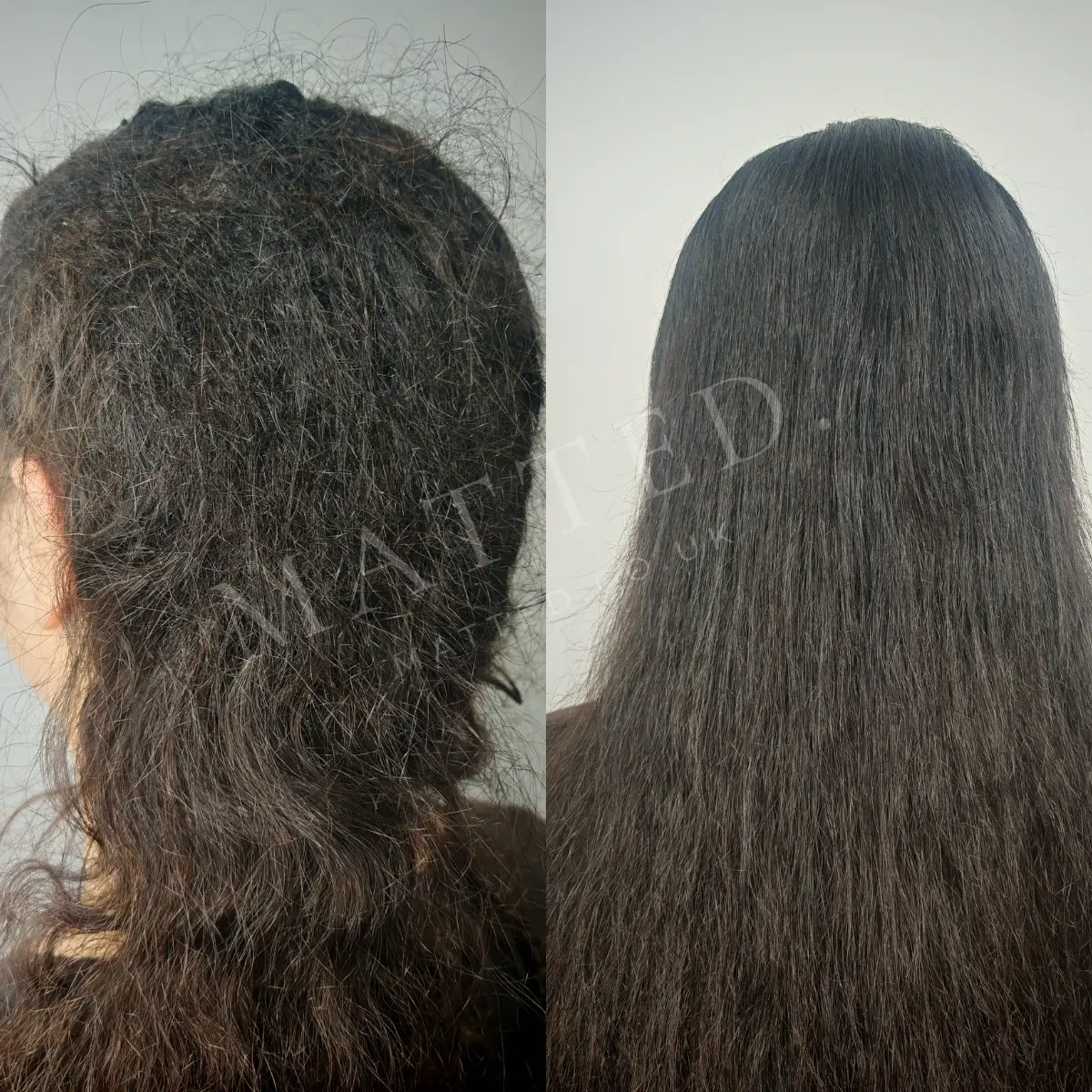
It Is Not Your Fault
If weeks passed and the hair was left, you are in the largest group in my case files, not in a category of your own. Forty-two per cent of severe matting followed depression, illness or a hospital stay. Matted hair is not dirt, it is not laziness and it is not a verdict on you. It is what hair physically does when brushing pauses, and it does the same thing to a nurse after night shifts, a mother after a birth and a patient after surgery.
The shame arrives before the photo does, and it is the shame that keeps people away for another month. Every month adds hours to the work. So here is the only thing I need you to know before you decide anything: I have opened hair that had been matted for two years, and the person in the chair was not asked a single question about how it got there. You can talk, watch something on your phone, sleep or say nothing. My job is the hair. Yours is to get through the door, or to open it when I arrive.
What You Can Do Today
What you can do today is small, and small is the point. None of it touches the mat itself, because touching the mat is what makes it worse.
01
Keep it dry
No washing, no steam, no damp towel. Wet hair stretches up to 30% before it breaks, and water swells the cuticle so the strands grip each other harder as they dry. If the hair gets wet by accident, dry it gently with warm air and do not comb it.
02
Plait what still moves
Any hair that separates under your fingers goes into two or three loose three-strand plaits, so it cannot be drawn into the mat overnight. If plaiting is too much today, a loose scrunchie low at the nape does most of the job.
03
Change what the hair sleeps on
A silk or satin pillowcase, or a satin bonnet, lets the hair slide instead of catch. It will not undo a mat, but it stops the loose hair joining it. This is the one habit that keeps working on the days when nothing else does.
04
Put nothing on it
Conditioner, oil and detangling spray coat the outside of a mat and add weight; they do not reach the knot. Every product makes the second attempt worse than the first. Slip goes on only once a section has started to open, and that happens in the chair, not in the bathroom.
05
Send one photo
The worst area, in daylight, from behind, on WhatsApp. You do not need to write anything with it. Most photos get an honest answer within the hour: the grade, the hours and the price, and whether I come to you or you come to me.
What Not to Do
Everything on this list is something a client of mine tried first, and 89% of recorded home attempts on severe mats made the professional work longer.
- Do not shave it or cut it. Cutting is the one step that cannot be undone, and 73% of my clients had already been told by another salon that it was the only option. It was not.
- Do not soak it in conditioner overnight. The water in the conditioner tightens what is underneath, and the weight pulls at a scalp that has already been under tension for weeks.
- Do not drag a comb or brush through the solid part. A comb through felt snaps the attached strands and feeds the broken pieces into the knot. Comb a tangle, never a mat.
- Do not pull with your fingers to test it. One test is enough: if the section moves as one piece, stop. Pulling is where the scalp soreness comes from.
- Do not wait for a better week. By the fourth week a mat holds 2,800 or more shed strands, and each week after that adds hours. A photo tonight costs nothing and commits you to nothing.
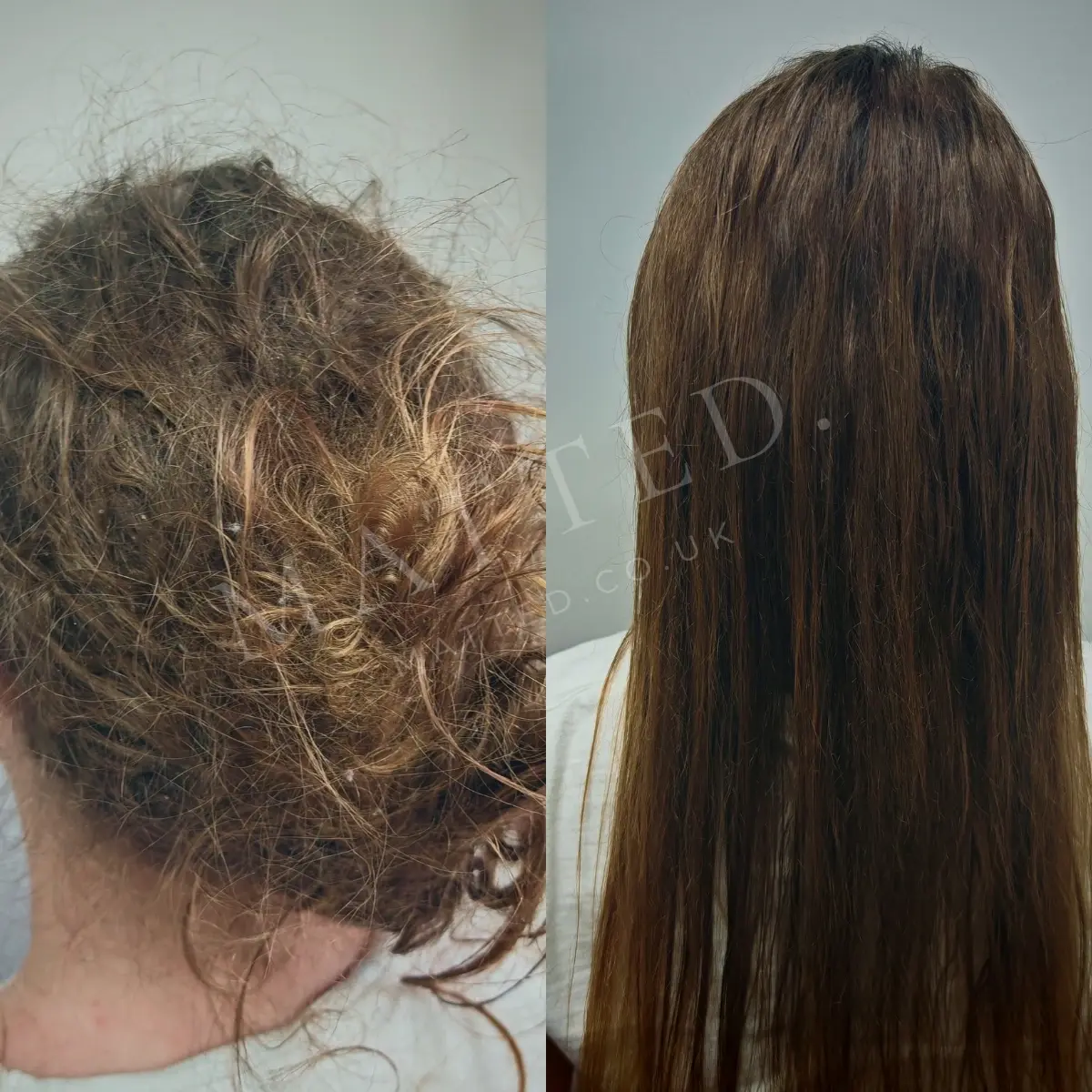
Can Matted Hair Be Saved Without Cutting?
Yes. Across 1,000+ documented cases since 2020, 99% of matted hair was saved without cutting, and the depression cases are not the hard ones; they are the ordinary ones. What decides the outcome is not how bad it looks or how long it has been left, but whether the hair shaft itself is still whole. A mat that has been there for months, one that sits flat against the scalp, or one that has been soaked and dried many times still opens; it simply takes longer.
Time changes hours, not outcome. Two or three weeks of not brushing usually lands at Grade 2 or 3 on my scale: dense tangling at the nape, three to nine hours of work. Two or three months is usually Grade 4, partial matting across the back of the head, ten to fourteen hours. Six months or more, where the head moves as one mass, is Grade 5: fourteen hours or more, sometimes across two sessions a week apart. The method for severely matted hair is the same at every grade: dry, from the ends upward, in small sections, fingers before any tool, and nothing applied to the mat first.
Two things to expect afterwards. You will see hair: what comes out of a mat is the hair that shed while it was forming, and it is not new loss. And if the mat sat tight against the scalp for a long time, the roots may be tender and the hairline thinner for a while; in my case files regrowth typically begins within three months once the tension is gone. If the scalp is sore, scabbed or patchy, see your GP; the NHS page on hair loss explains when to ask.
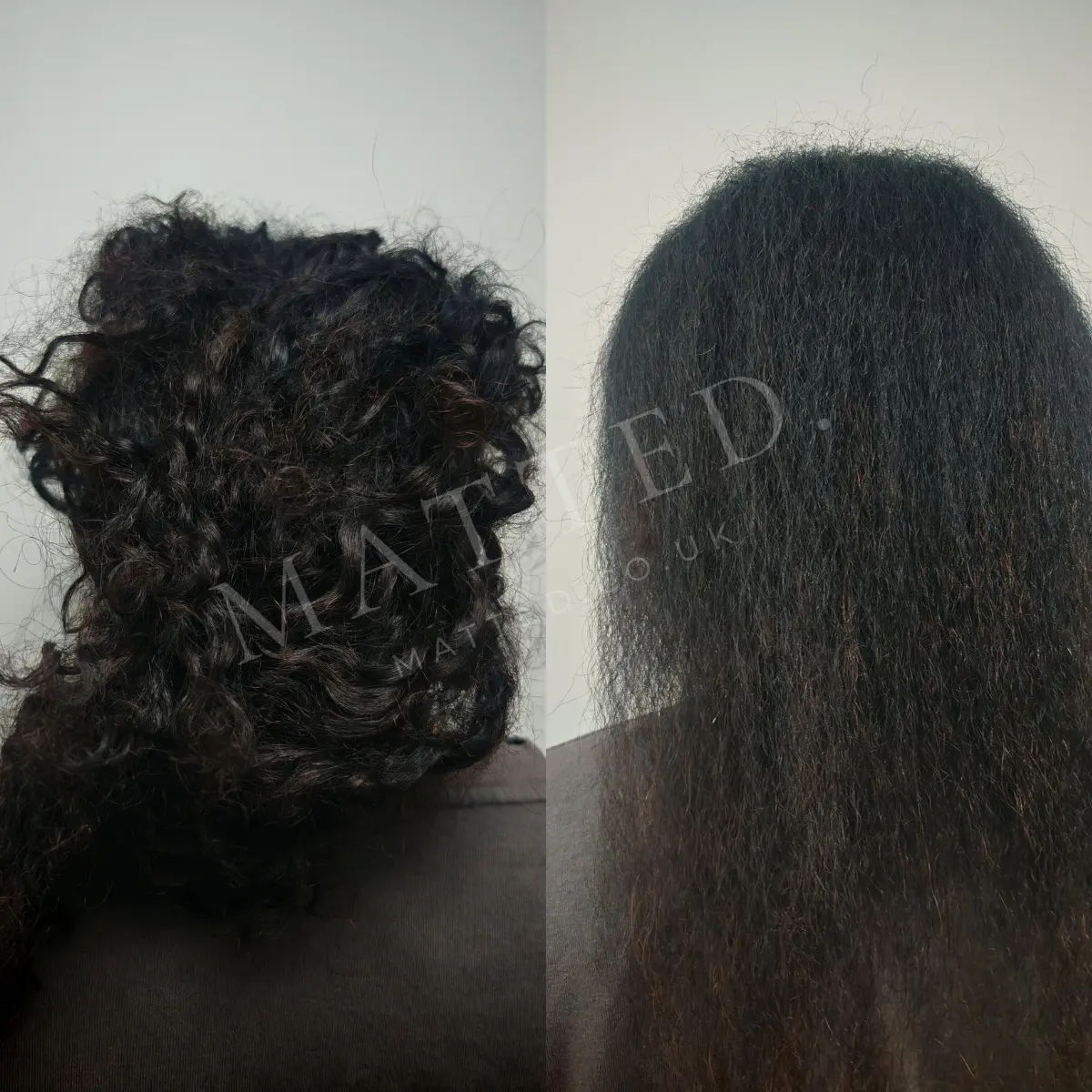
How a Home Visit Works
If the studio in Catford is one step too many today, I come to you. A home visit anywhere in London is £100 per hour plus a flat £200 for travel and equipment, and the assessment from a photograph is free either way. I arrive with everything: the products, the lighting, the towels, single-use items and Barbicide disinfection between clients, the same as the studio.
The pace is yours. We can work with a film on, with music, in silence, or with someone you trust in the room. Breaks happen whenever you want them, and if the hours are long we can split them across two days. Nobody else needs to know I was there. I hold certificates in Mental Health First Aid for Hair and Beauty Professionals, Trauma-Informed Haircare and Safeguarding Adults and Vulnerable Clients, all listed on the credentials page, and the work is priced before it starts: a £100 deposit comes off the total, and Klarna pay-in-3 at 0% is available. Details of the London matted hair removal service are on their own page.
For Family, Partners and Friends
If you are reading this for someone else, the most useful thing you can do is the least dramatic one. Do not offer to cut it, do not buy a detangling product, and do not comb it for them. Keep their hair dry, help with a loose plait or a satin pillowcase if they will let you, and take one photo of the back of the head for them if they cannot face it. Send it to me yourself if that is easier; I will answer you and they can decide later.
When the day comes, be in the room if they want you there and out of it if they do not. Do not narrate the hair. What they need to hear from you is the same thing they need to hear from me: it can be saved, it is not their fault, and nobody is going to ask what happened.
If You Need Someone to Talk To Tonight
This is a page about hair, and I am a hair specialist, not a counsellor. If the low mood behind the matting is still there, or you are struggling tonight, please talk to someone who is trained for that: your GP, NHS 111 (call 111, or 111.nhs.uk), or Samaritans on 116 123, free, any hour. Sorting the hair does help, and I have watched it help hundreds of times, but it is one step, and you deserve the others too.
From 1,000+ documented matted hair cases: 42% of severe matting followed depression, illness or a hospital stay, the largest cause in my files. 99% of all cases were saved without cutting, and 73% of clients had already been told by another salon that cutting was the only option.
Frequently Asked Questions
How do you fix matted hair after depression?
The same way as any other mat: dry, from the ends upward, fingers before any tool, and nothing applied to the mat first. What is different is the pace and the room. Across 1,000+ documented cases, 42% of severe matting followed depression, illness or a hospital stay, and 99% of all cases were saved without cutting. You can send a photo on WhatsApp tonight; the assessment is free and nobody asks what happened.
Is matted hair a sign of depression?
It can be, and in my case files it often is. Matted hair is what happens when brushing stops for weeks: the 50 to 100 strands shed each day stay in and lock around the growing hair. Depression is the most common reason brushing stops, but illness, a hospital stay, grief and postpartum exhaustion do the same thing. The hair shows the gap, not the person.
How do you detangle hair that hasn't been brushed in months?
Not at home, and not with product. Months of matting is Grade 4 or 5 on my scale: ten to fourteen hours or more of dry, strand-by-strand work, sometimes across two sessions a week apart. Keep it dry, plait what still moves, put nothing on it, and send a photo. It comes out; 99% of 1,000+ cases did.
Will a hairdresser judge me for matted hair?
Not here. Matted hair after depression is 42% of my severe cases, the largest group I see, so it is the ordinary work of this studio, not the exception. You can talk, watch something, sleep or say nothing. I hold Mental Health First Aid and Trauma-Informed Haircare certificates, and the door is private.
How much does it cost to fix months of matted hair?
£100 per hour, with a free 10-minute estimate from a photo first. Dense tangling at the nape is Grade 3, £600 to £900; partial matting is Grade 4, £1,000 to £1,400; a full fused head is Grade 5, from £1,400. A £100 deposit comes off the total, Klarna pay-in-3 at 0% is available, and a home visit anywhere in London adds a flat £200.
Does detangling matted hair hurt?
It should not, and if it does, something is being done wrong. I hold each section above the mat so the scalp feels nothing, work from the ends up, and stop for breaks whenever you want them. Pain at home is a signal to stop pulling. What you will feel is time: hours, not pain.
Will I lose a lot of hair?
You will see hair come out, and almost all of it is hair that had already shed while the mat was forming: 50 to 100 strands a day for as many days as it was left. It looks like loss because weeks of it are released at once. Your growing hair stays attached because nothing is cut and nothing is pulled through a knot.
Send a Photo When You Are Ready
One photo of the worst area, in daylight, from behind, is enough. You will have the grade, the hours and the price back before you decide anything. £100 per hour at my Catford studio, three minutes from Catford Bridge, or at your home anywhere in London for a flat £200 more. The £100 deposit comes off the total, and you can pay in three at 0% with Klarna. Let me carry the hair. You carry yourself through the door.